

Categories
Articles

Explore your benefits

EXPLORE YOUR BENEFITS

We’ve got your back

No one can do it all themselves. Each of us needs help and community, especially when we’re making changes in our lives. That’s why Costco offers a wide range of benefits resources to help you with all areas of your well-being — so you always feel supported and never feel like you have to do it on your own.

As you gear up to pursue your goals for the year, commit to getting to know your benefits and, if you haven’t already, take the pledge. Encourage your spouse or domestic partner to take it, too. And prepare to celebrate each accomplishment you make along the way.

Print

Looking for more? Find other articles below

manager supporting employee

A strong foundation for emotional, financial and physical well-being

Your Costco benefits provide the care you need to flourish. They can help you:

Live a longer, healthier life

Costco medical and dental plans cover preventive care at 100% when you see an in-network provider. Preventive care includes physical exams, dental checkups and cleanings, some cancer screenings and certain age-appropriate immunizations. This routine care can help you stay well and catch health concerns early, lowering your risk for disease and disability.

Get help for a serious health challenge

Live Healthy Team* Coaches can help employees and their families enrolled in an Aetna® medical plan create an action plan, connect to the right resources and coordinate care when you’re diagnosed with a serious health condition. You can also use 2nd.MD to get a second opinion on your diagnosis or treatment plan, and connect with Resources For Living (RFL) to get emotional support services, including counseling and daily life assistance.

Manage a chronic condition

Omada for Diabetes, Hypertension & Prevention provides personalized online programs to help you make healthy choices when living with a chronic condition. You’ll work with a dedicated health coach and a clinical specialist to get the support and tools you need to make simple changes for a healthier life.

Find mental health support

RFL has a team of care partners that can help with challenges such as stress management, work-life balance, relationships, grief, depression, anxiety, substance misuse, self-esteem and personal development. They offer in-person or virtual counseling, daily life assistance, disaster relief, help with child or elder care, and more. You can also use Supportiv for online peer-to-peer support.

Deal with parenting challenges

RethinkCare gives your family 24/7 access to tools, webinars and resources to help you understand, teach and better communicate with your children, including those with developmental or learning challenges. You can also try Supportiv for peer-to-peer parenting support.

Quit tobacco or get support for drug and alcohol misuse

Costco Tobacco Cessation Program pairs you with personal support to design a plan to help you quit tobacco for good. And if you or someone in your family is struggling with drugs or alcohol, RFL can help you find in-network rehabilitation facilities and provide behavioral health support services.

Go through a life change

Your Costco benefits are there for you when you’re building a family, buying a home, going through a divorce or coping with the loss of a loved one. Resources to help with these transitions include the Adoption Assistance Program, the Aetna Maternity Program* for help with infertility and postpartum challenges, and RFL for legal and financial consultations and grief counseling.

Create a stable financial future

T. Rowe Price manages the Costco Retirement Plan that helps you save for your future. Costco will make contributions to your account even if you don’t. You can also use SmartDollar® to take control of your finances and pay off your debt, and spend less on taxes with a Health Care Reimbursement Account (HCRA)** and a Dependent Care Assistance Plan (DCAP).**

Whatever you’re looking to achieve, use your Costco benefits to help you get there. Learn more about some of the resources available to you below.

*Available on the Mainland only.
**Not available in Puerto Rico.

Categories
link

Check out

Categories
link

Check out

Categories
link

Check out

Categories
Articles

Thanks for everything

THANKS FOR EVERYTHING

Pat yourself on the back

You’re amazing! It’s been another challenging year, and you’ve met the challenge. Thank you for your hard work and everything you do to make Costco a great company.  We wish you and your family a wonderful holiday season.

Print

Looking for more? Find other articles below

Thank you for all you do to make Costco a great company!

In the past year, you and over 68,000 of your fellow Costco employees took the We’re in This Together pledge to make your emotional, financial and physical well-being a priority. You explored your Costco benefits and learned how they can help you reach your goal. Many of you even inspired others by sharing your stories on our well-being portal. And over 150,000 of you receive our monthly well-being emails.

You did it. And you should be very proud. 

quote mark

As I’ve stated before, nothing is more important than your well-being and that of your family. That’s why our ongoing promise to you and your family members is to provide access to health care resources and programs that help you get the right care, at the right time and at an affordable price.

Craig Jelinek, President and CEO

Categories
Articles

Take the pledge

TAKE THE PLEDGE

Wishing you a happy, healthy 2022

As part of Costco’s ongoing commitment to your well-being, you can take advantage of enhanced benefits, starting January 1, 2022. With these benefits, you’ll enjoy more convenient access to many high-quality services that support your emotional, financial and physical well-being.

From one-on-one therapy and coaching sessions to expert medical second opinions and 24/7 virtual access to a doctor, your enhanced Costco benefits are here to support and encourage you — on every step of your well-being journey.

Print

Looking for more? Find other articles below

New in 2022

Starting in January, learn how your enhanced benefits will impact all areas of your well-being — emotional, financial and physical. And see how they can help you make progress in these important areas of your life.

Get your partner involved!

For the first time, your spouse or domestic partner can take the pledge and join you on your well-being journey. Together, you can encourage each other as you work on your goals, with support from your Costco benefits and resources.

Visit our well-being portal  

Want to give your well-being journey the best possible start? Make sure your first stop is here, on our well-being portal. You’ll find personalized resources to help you reach your emotional, financial and physical goals each month. Plus, tools, tips and information about Costco benefits and programs that can help you on your well-being journey.

With so much at your fingertips, you’re sure to find something that can help you with your goals. You can read, watch, grab quick tips — whatever works for you. We’ll email you each month to let you know when new content is added. So visit often and explore.

Take the pledge starting January 3, 2022  

Mark your calendar now, so you’re ready to take the 2022 pledge. We’ll send you an email reminder, too.

Let’s make it a great year!

Categories
Articles

Be aware

TAKE ACTION

Know the signs of suicide risk

Suicide is on the rise in America, claiming tens of thousands of lives each year. We all have a responsibility – and an opportunity – to recognize the signs and symptoms of suicide risk in ourselves and others. Awareness can lead to prevention, and to lives saved.

Print

Looking for more? Find other articles below


Watch, listen, be aware

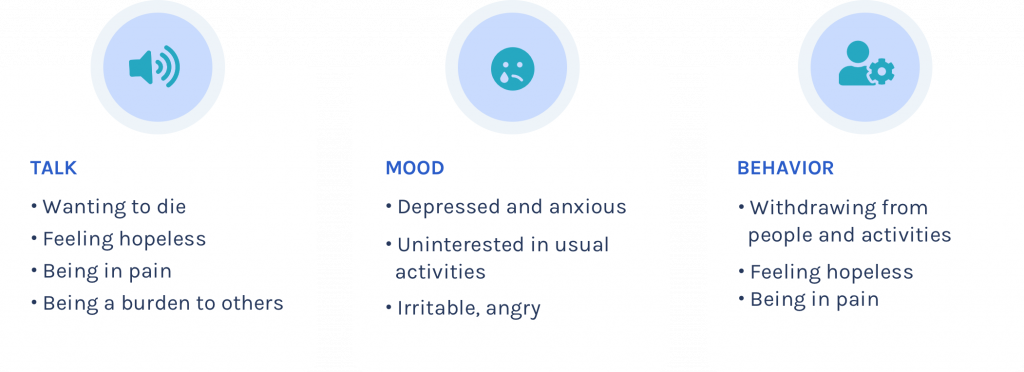
Many people thinking of suicide have these changes in talk, mood, and behavior in common:

Some people are good at hiding their distress, and you may not notice any changes or other signs at all. But there are factors that make it more likely that someone will consider and/or attempt suicide. A relationship breakup, a history of abuse, the loss of a job, a mental health condition and genetics can all put a person at risk.

If you see these signs in someone or in yourself, take them seriously. Here are some things you can do:

Ask. “Are you having thoughts of suicide?” It’s not an easy question, but asking someone who’s going through a crisis lets them know you care. It also helps you know what they’re thinking so you can support them.

Keep them safe. Reducing a suicidal person’s access to highly lethal items is an important part of suicide prevention. This means removing or locking up medications, firearms, and items they could use to hurt themselves.

Be there. Sometimes the best thing we can do is listen. Take the time to hear how someone who is struggling is feeling.

Follow up with them. Studies show that the number of suicide deaths goes down when someone who has thoughts of suicide is followed up with. Be that person.

And, help them connect with resources available to them through their Costco benefits.


Categories
Articles

Take Action

TAKE ACTION

What you can do to prevent suicide

If you or someone close to you is in distress to the point of considering suicide, there are ways to help — and save — your life or theirs. If you’re unsure about how to talk to someone about suicide, begin with learning the signs of someone in danger. Recognizing signs of suicide risk is essential. But sometimes the most important actions are the simplest – listen and talk.

Print

Looking for more? Find other articles below


It’s hard to talk about feelings – especially difficult, negative feelings. People who are at the end of their rope often don’t reach out for help, seeing their distress as a sign of weakness. In fact, it’s a sign of strength to share and connect with others. Here are three important ways you can make connections for yourself or someone you care about.

1. Ask and listen

People can be afraid to ask someone if they are considering suicide, thinking it may spur them to follow through. In fact, that’s not the case. Asking means you care and lets the person express what they’re going through. Listening makes the other person feel seen and heard.

2. Talk

If you’re the one feeling overwhelmed and hopeless, take those feelings seriously. Know you are not alone, and reach out to a friend, co-worker, trusted doctor, or family member for help. Be honest about your pain; don’t minimize or downplay it.

3. Connect

Know you’re not alone. You have friends, family and co-workers who care about you. Learn about the resources available to you and others 24/7. Don’t wait – help is available now.


Categories
Articles

Take care of you

TAKE ACTION

A recipe for self-care

Suicide can seem like an option when a person loses their ability to cope with feelings such as anxiety, depression and loneliness. To minimize these feelings, it’s important to take care of yourself through self-care. See how you can work self-care into your daily routine to improve your physical and emotional well-being.

Print

Looking for more? Find other articles below


Any recipe depends on the right combination of ingredients. Our recipe for self-care is a mix of healthy habits and practices that support your well-being and strengthen your ability to cope with life’s challenges.

Connect with people
Who is important to you? Make time to call, text, or visit friends, family, co-workers, neighbors, or members of your church.
Do things you enjoy more often
Maybe it’s as simple as reading a book or taking a drive. Use more of your time off for pleasure. The to-do list can wait.
Slow down
When life gets hectic, take a few moments to pause and breathe. Try yoga or meditation sessions online or find some good apps.
Live healthier
Eat healthy food and add more fruit and vegetables to each meal. Exercise 20-30 minutes each day, doing activities that make you happy. Get plenty of sleep each night so you feel energized in the morning. Keep up with routine checkups and talk with your doctor about any problems and concerns. Seek help to quit habits that are not healthy for you – such as using tobacco, vaping, or drinking more than two or three drinks per week.
Reach out
If you’re struggling, the resources below can provide help and support.


Categories
Articles

Know more

TAKE ACTION

Tweens, teens and suicide

The rise in suicide among tweens and teenagers is a disturbing trend. It’s become the second leading cause of death in people ages 10 to 241, ahead of cancer and heart disease. Get the facts and know what you can do to help protect the young people in your life.

Print

Looking for more? Find other articles below

The tween and teen years are a vulnerable time. Everyday stresses — school difficulties, family conflicts, breakups, bullying — make it difficult to cope. They may have trouble seeing the temporary nature of these problems, and suicide can seem like a solution. Understand how to tell if your tween or teen might be suicidal, and know the resources available to help.

How to help

Talk and listen. Feeling connected to family and school is one of the most important things for a younger person’s mental health. An important first step in helping them is to talk and listen. Ask how they are feeling and offer support. Start by saying, “Sometimes people who are struggling may think about suicide. Is this happening with you?” Make sure they know you care.

Engage others for help. If there is a teacher, coach, or staff member at school your child is close to, you may want to have a conversation with them and include your child if possible. You can also contact your family doctor for help and referrals to the right mental health professional(s) near you.

Keep them safe. Be sure to safely store or lock up firearms, alcohol, and medications. Easy access can turn risk into action if a teen is feeling overwhelmed.

Give them a hug. It seems like such a simple thing, but taking the time to hug your child and tell them you’re there for them can help them feel a sense of security.

Did you know? More than 1.8 million LGBTQ young people seriously consider suicide every year in the U.S. To learn more and know how to support an LGBTQ teen, call The Trevor Project’s Lifeline at 866-488-7386.

1The Jason Foundation. Youth suicide statistics. Accessed July 13, 2021.